The Interview: David Johnston
Professor David Johnston (Professor, Operations Management) is the Director of the George Weston Ltd. Centre for Sustainable Supply Chains at the Schulich School of Business at York University. He is the founding and current program director of the Master of Supply Chain Management (MSCM) at Schulich. In addition, he is the former director of the Master of Business Analytics (MBAN) and Master of Management in Artificial Intelligence (MMAI) programs.
David has over 35 years of experience as an educator and researcher in the management of operations and supply chain management, working with organizations in many sectors of the economy. Dr. Johnston’s published research focuses on collaborative supply chain management, operational sustainability, improving healthcare operations, and the management of process innovation.
Hi David! Please, tell us a bit about yourself!

I’ve had a long career as an academic trying to figure out what the important questions are that should be asked to make better decisions.
I became an academic because I wanted a career and a life that was dedicated to the pursuit of purpose-driven curiosity. I grew up in a culture that valued working hard and smart – it’s probably no surprise that I am curious about how best to get things done.
I also wanted to do something where I would have the opportunity to create. Academic research is a license to entrepreneurially find new solutions to important problems whether they be new products, processes or policies and procedures.
Your early work focused on innovation, but your current work focuses heavily on supply chain management – did you find that these were related topics? Or was this an evolution of your interests over time?
My work on innovation is foundational for my work in supply chain management.
My early work focused on the power of social networks within organizations and industries to spread incremental process innovations quickly to many potential users thus leveraging local investments into global ones.
“I became an academic because I wanted a career and a life that was dedicated to the pursuit of purpose driven curiosity”
One thing essential for innovation in supply chains is trust: namely, the trust between buyers and sellers. That trust leads to the transparency and information sharing that leads to effective collaboration that in turn leads to better coordination and the adoption and implementation of innovations to solve common problems and avoid risks. Increasingly that entails the design and delivery of products the right way that reduces their harm to the natural environment, the people that make and deliver them and communities.
If we do all this right, products are available on the shelf of your local store at the right price, quantity, and quality.
So, how does this worldview inform your research?
The things I research and explore are informed by the discipline of operations management, which focuses on the integration of process, products and people to get work done right. I can be passionate about the worldview that this discipline provides because when appropriately applied it can benefit people and planet as well as eventually profitability.
For example: organizations that create safe work environments for their employees get from them a focus on productivity and flexibility of thought that produces process improvements that echo up and down supply chains whether that is in manufacturing, mining, or healthcare.
It seems like you have a strong set of values, principles, and unique interests that have shaped your academic and professional interests. What do you think shaped your worldview in such a way?
I have always tried to be engaged in my community by thinking globally, acting locally. It’s one thing to be caught up in big ideas and events but it is our actions and interpersonal relationships with the people we live and work with which define us as people, and which is something that gives our lives balance.
Being creative and experimenting with others honours that principle – as York’s motto says: “Tentanda Via” (“The Way Must Be Tried”). It also can be great fun and rewarding. You still have to put in the work and get stuff done.
This work ethic probably comes from my family and friends growing up in Northern Ontario. My father leveraged his high school education to become a senior manager of transportation and logistics in the mining industry. This involved managing an extensive supply network of small and medium-sized suppliers. Talking “shop” around the kitchen table was a norm growing up. The culture took pride in working hard but also working smart.
Changing gears to the personal: tell us a little bit about your musical career!
When I am not an educator, researcher, and advocate, I am making music. Songwriting and performing – like academia – demand that you find your voice and audience by putting in the time, practicing your craft and innovating with others. I have been a songwriter since I was 12 years old!
In university I started playing music with others in amateur rock bands. Like being on sports teams, you develop strong personal bonds, learn valuable life lessons about working with others and manage your own performance in the context of others.
Later, I started singing and playing solo in bars and cafes as a hobby and produced a couple of CDs of original material. Nowadays I put on shows with musical friends close to where I live, and still belong to a performing choir and songwriting circle.
Current Work
You head the Master of Supply Chain Management (MSCM) program at Schulich, so, help me answer this question: “What is a supply chain?”
Technically, as soon as you have one person doing something for another person, you have a supply chain.

But, if I were to give you an answer that I would say in a classroom I’d say that “A supply chain is the entire network of organizations, their people, activities, information, and resources, involved in creating and delivering a product or service from raw materials to the end consumer.”
How well these organizations cooperate in planning and coordination of their capabilities and capacity determines how productive and ultimately how profitable each will be.
What happens when these groups don’t work well together?
Supply chains are vulnerable to disruption. Consumers may face product shortages and higher prices, essential services can fail to be delivered and the wider economy becomes less productive.
The management of modern supply chains requires integrated work across multiple functions such as customer service, logistics, demand planning, purchasing and manufacturing functions. Then between firms who do business with each other in the chain. They can involve other stakeholders such as government and public institutions. If you do it right, you have a symphonic harmony that keeps economies safe and growing.
For this reason, the George Weston Ltd. Centre for Sustainable Supply Chains views effective supply chain management as both a business priority and an important contributor to Canada’s economic resilience.
Given that we’ve seen major issues related to supply chains being thrust into the news lately ( blockades, disruptions from pandemics, etc.) have you seen an increased interest in the MSCM program from students?
Yes. As you might imagine, this level of interest started during the Covid-19 epidemic when we had shortages of everyday goods as well as critical commodities such as personal protective equipment (PPE). When a “black swan” event like Covid-19 comes along, it can significantly disrupt supply chains and make them incapable of delivering critical goods like food, drugs and medical supplies. When that happens, we end up with a crisis where people suffer.
We’re seeing many politically driven disruptions taking place, which is causing supply chain managers to scramble to serve their firm’s customers. They are the front line in protecting national economic sovereignty and motivating the development of new supply networks to new customers and suppliers.
Stepping back a bit, fundamentally, students are drawn to the Supply Chain Management (SCM) program because it offers jobs solving real-world problems that they witness as relevant to their communities every day.
Students are drawn to the ability to study something that they see as practical or tangible, I’m guessing.
Getting food, energy, housing, and medicine delivered or produced for ourselves, our families, and our friends is not an abstract task. We are all shoppers and want the right product, at the right price, in the right quantity, with the right quality at the right time, to the right location done the right way.
Day-to-day supply chain management means that we work to make sure what I call the 7 Rights happen, which is part of “The 7-7-7 Framework for Sustainable Supply Chain Management.”
How about within academia? Have you seen an increase in opportunities for interdisciplinary work?
The natural home for Supply Chain Management in business schools is Operations Management, but supply chain management has become an aspect of research in other management disciplines such as industrial marketing, accounting, strategy, international business and organizational behavior. Disciplines, such as industrial engineering, have a long-standing interest in components of supply chain management, such as logistical and transportation systems.
The George Weston Ltd. Centre for Sustainable Supply Chains
You’re the Director of the George Weston Ltd. Centre for Sustainable Supply Chains. The Centre launched in 2021, which I can’t help but notice, would place it in the midst of the COVID epidemic and the associated supply chain disruptions and shutdowns. That certainly must have been an interesting time to start!
Did you find that this influenced the type of work that the Centre originally promoted and supported?
It did. We started in 2021 coping with disruption and how to build resiliency into supply chains. We launched the Centre during the pandemic when we were still social distancing. We wanted to make an immediate impact on our local community’s businesses and institutions.
We partnered with Loblaws to study how they managed Covid-related disruptions in their supply chain, which ran from farmers to consumer-packaged goods producers to freight carriers to their stores. We also worked locally with the City of Toronto to help them secure their supply of personal protective equipment for employees and the public. In the process we became very interested in the supply chains of government and public institutions and specifically their procurement practices.

Has your focus changed over the past 5 years?
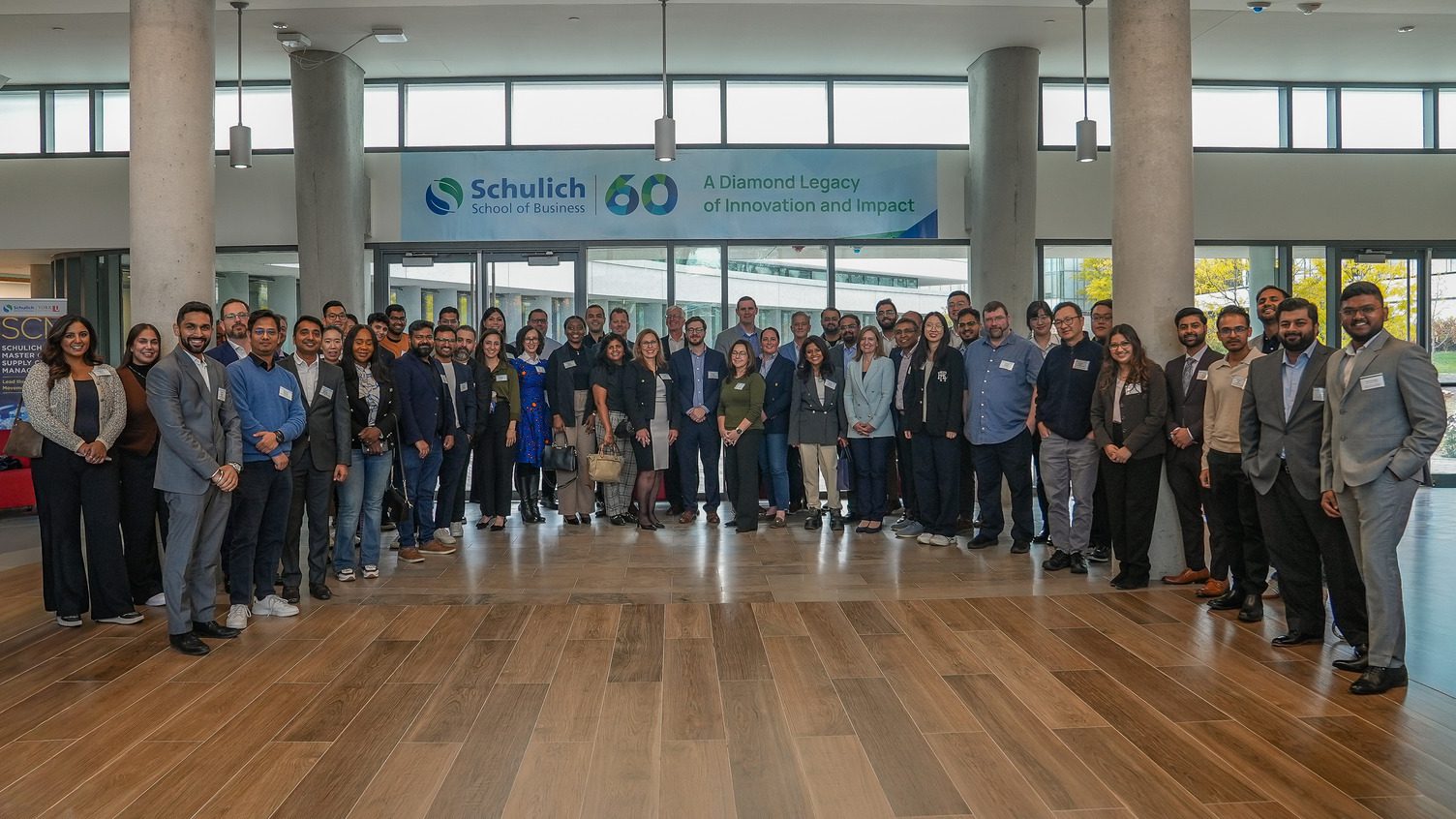
Not substantively. Our focus is still on designing supply chains that resolve the trade-offs and achieve the synergies of a triple bottom line of positive environmental, social and economic outcomes. We have evolved from experimentation to having repeated programs. For example, our annual Supply Chain Management Research Forum for enabling academic SCM research in Canadian business schools has grown year by year.
We also sponsor two research initiatives: Ensuring Resilient and Robust Supply Chains (which led to the publication of an MIT Sloan Management Review article Get Ready for the Next Supply Disruption by M. Johnny Rungtusanatham and myself) about how firms can proactively manage risks associated with disruption, and the Sustainable Public Procurement Lab, which is currently working with five municipal governments on implementing sustainable procurement (paper coming later this year).
You can read our profile on the George Weston Ltd. Centre for Sustainable Supply Chains here
Parting Remarks
What are you working on right now?
Personally, I am busy working on finishing the research mentioned above on sustainable procurement and another on how companies are managing their supply chains to cope with the current USA-triggered trade war. I am also working with one of my PhD students, Sunny Tian, and supervising her doctoral research on sustainable supplier selection and management.
I am also working on an exciting new initiative that involves examining how artificial intelligence is changing work in supply chain tasks. This is in collaboration with academic colleagues at other Canadian and European business schools and industry partners. We have applied for SSHRC funding in fall 2026.
In a related project associated with the Centre’s goal of strengthening Canada’s supply chains, I have been working with Hjalmar Turesson, Program Director of the Master of Management in AI program, on how to secure data and AI technology domestically that is created and used by Canadians. We recently published an op-ed in The Globe and Mail and tried to address a small part of this big topic.
We also continue to support doctoral research that is relevant to the better management of supply chains that impact the sustainability of Canadian supply chains. Come to next year’s 7th SCM Research Forum hosted by the Asper School of Business, University of Manitoba to see what we are up to!
Thanks David!