

Centre Profile: George Weston Ltd. Centre for Sustainable Supply Chains
Launched in 2021, with support from George Weston Ltd., the George Weston Ltd. Centre for Sustainable Supply Chains is a Centre of Excellence that supports the development of the next generation of supply chain professionals, advances academic and applied research on pressing issues, and engages industry to collaborate on potential solutions.
The Centre recently renewed and expanded its partnership with George Weston Ltd. from 2025 through to 2030.
We sat down with the Centre’s Director, David Johnston, to ask a few questions about the Centre’s past, present, and future.
David, what can you tell us about the Centre?
The George Weston Ltd. Centre for Sustainable Supply Chains is Schulich’s Centre of Excellence for advancing the knowledge, leadership, and collaboration needed to build more sustainable and resilient supply chains.
“Sustainable” in this context means building supply chains that meet long-term economic needs while also being accountable for their environmental and social consequences. “Resilient” means being able to anticipate, diagnose, detect, activate resources for, protect against, and track both known and unknown-but-knowable threats.
This is important because a supply chain is not being effectively managed if it is efficient but causes irreparable environmental and social harm. Such supply chains must also be strengthened to respond to disruption, whether from extreme weather, new technology, or unforeseen political and market events.
What is the mission of the Centre?
The Centre’s mission is to help organizations design resilient supply chains that balance the long-term needs of people, planet, and profit. This involves supporting educational initiatives, advancing research, and collaborating actively with industry.
Our Centre helps to educate supply chain leaders who have the situational awareness needed to do what is best for their organization’s customers, employees, suppliers, and community. This is not always easy. It requires a temperament suited for data-driven insight, as well as communication and people management skills that can allow them to deliver on a compelling vision of the future.
Regarding research, the Centre advances research and thought leadership at the intersection of rigorous academic thinking and practical management problems. This means helping researchers to better understand the challenges that organizations face, while giving practitioners access to evidence, analytical frameworks, and emerging ideas that can improve decision-making.
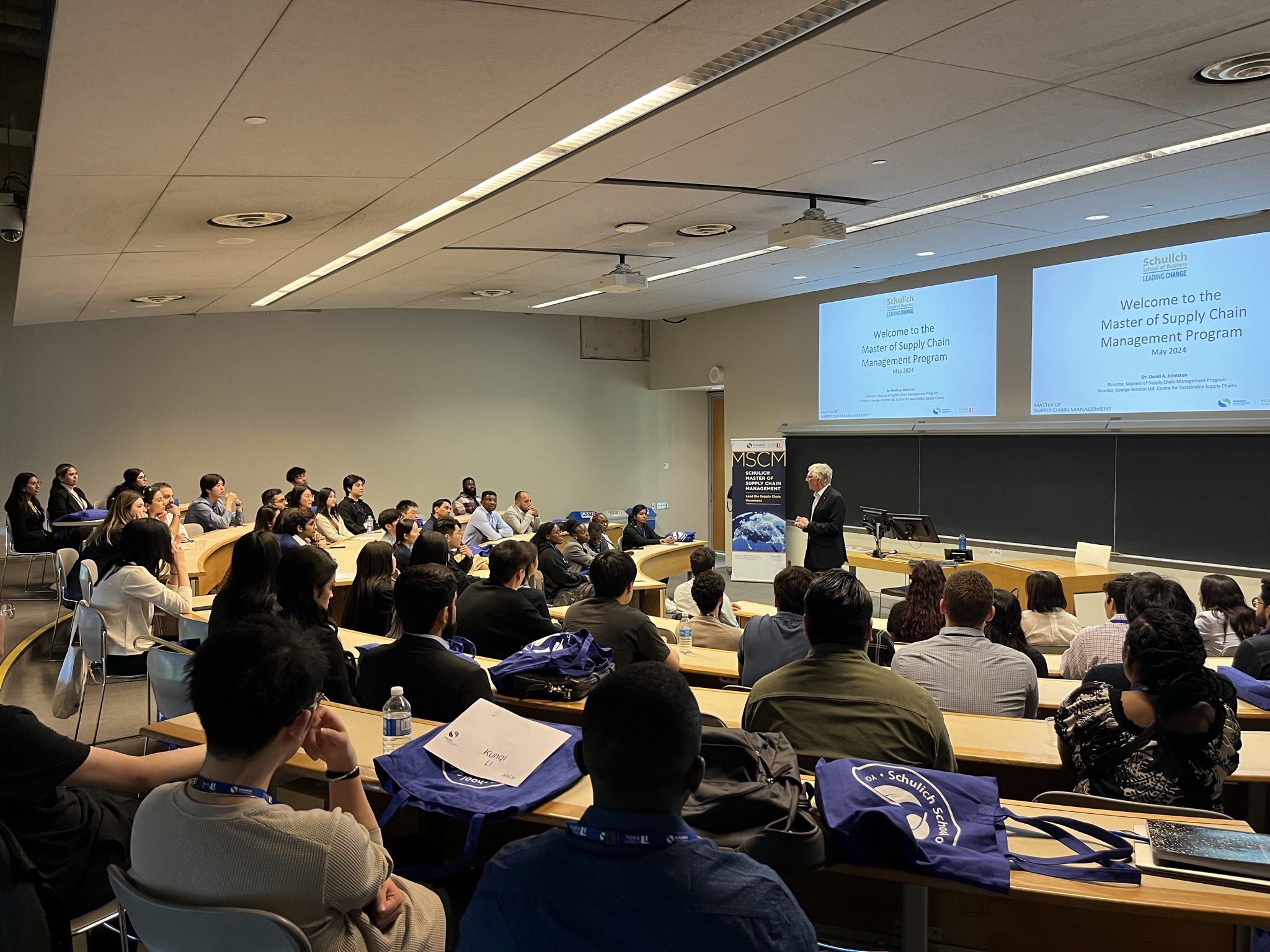
In all of our work, the Centre brings together a diverse group of stakeholders to collaborate on potential solutions. This includes faculty, researchers, students, alumni, industry leaders, as well as private, non-profit, and public-sector organizations.
Can you tell me about the Centre’s approach to research?
The Centre operates a portfolio of research programs in priority areas to address the long-term sustainability of supply chains. We collaborate actively with a wide range of researchers to address significant current questions, including how artificial intelligence may change supply networks and supply chain work; how organizations make trade-offs between cost and sustainability in various industry sectors; how procurement practices can support environmental and social objectives; and how digital capabilities can strengthen responses to disruption.
Our research findings are shared through peer-reviewed publications, white papers, media commentary, presentations, and teaching materials. Additionally, our research insights are brought into the classroom so that management education can actively adapt to reflect contemporary evidence and practice.
The Centre has a role in delivering Schulich’s Master of Supply Chain Management (MSCM) program. What can you tell us about your role in delivering the MSCM?
Experiential learning is critical to the education of future Supply Chain Management (SCM) professionals. The Centre works to coordinate and support a range of extracurricular and experiential learning opportunities for students in the MSCM program and other Schulich programs. In addition, we have an annual case competition for all Canadian universities focused on achieving sustainable supply chains.
One of the most prominent examples is supporting the MSCM’s Student-Industry Consulting Project course. The capstone course involves teams of MSCM students working with a local organization to develop recommendations that will make an organization’s supply chain policies, practices, and systems more efficient and resilient. The students learn to ask good questions, conduct data-driven research, and then communicate the results effectively to senior management.
Since 2020, MSCM student teams have completed over 80 individual consulting projects with a range of client organizations, impacting both the financial and operational performance of the client companies as well as their sustainability.
How successful has this approach been?
Experiential education opportunities are one of the reasons the MSCM program has ranked #1 in Canada in the QS Business Master’s Rankings for the third consecutive year, and is recognized among the top supply chain management programs globally.
Taken together, the Centre’s activities support a clear purpose: strengthening Canada’s capacity to develop knowledgeable, responsible, and adaptable supply chain leaders. This, in turn, builds supply chain knowledge and capabilities that benefit businesses, communities, and Canadians alike.
You recently organized the 6th annual Supply Chain Research Forum – what can you tell us about it?
Since 2021, the Supply Chain Research Forum has pursued an agenda that adapts to a world of geopolitical turbulence, technological change, and tensions and trade-offs between economic, social, and environmental goals.
This year’s forum was no exception.
We view the forum as an opportunity to bring together Canadian-based academics to discuss emerging research on designing, optimizing, and sustaining supply chains in the face of these real-world challenges. We also bring representatives from industry and government into conversations to share their insights about how they respond to supply-chain related issues, as well as provide insights into best managerial practices. It’s our hope that this dialogue between industry and academia will stimulate the next wave of researchers and research questions.
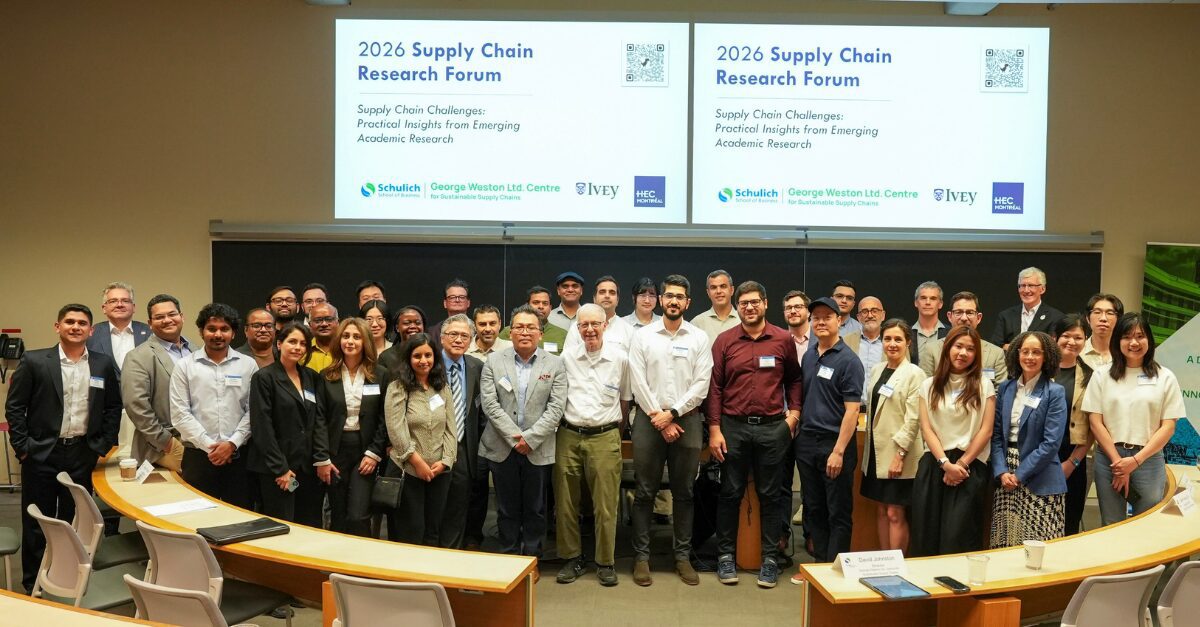
In the spirit of collaboration, the George Weston Ltd. Centre for Sustainable Supply Chains organized this year’s forum with support from HEC Montréal and the Ivey Business School (Western University). Planning is now underway for the 7th Annual Research Forum to be hosted in 2027 at the Asper School of Business, University of Manitoba, with support from Asper’s Department of Supply Chain Management.
What do you see in the future for the Centre?
The Centre will continue to deliver on its educational, research and outreach programs, whether that be through our Supply Chain Research Forum, the Sustainable Supply Chain Case Competition, or the GWL Women in Supply Chain Mentorship program, among other initiatives.
The Centre’s programs create a tangible impact for the stakeholders that we serve that compounds over time. We are excited to continue to deliver value for the communities that we serve. This means continuing to create a gathering space for supply chain faculty, researchers, students, alumni, and industry leaders to meet, discuss, and collaborate on the solutions needed to make supply chains more resilient and sustainable.
Thanks David!
The George Weston Ltd. Centre for Sustainable Supply Chains is housed at the Schulich School of Business, York University.
For more information about the Centre, contact the Centre at gwlscc@schulich.yorku.ca – and give them a follow on their LinkedIn page!

