Schulich Community Marks National Day for Truth and Reconciliation
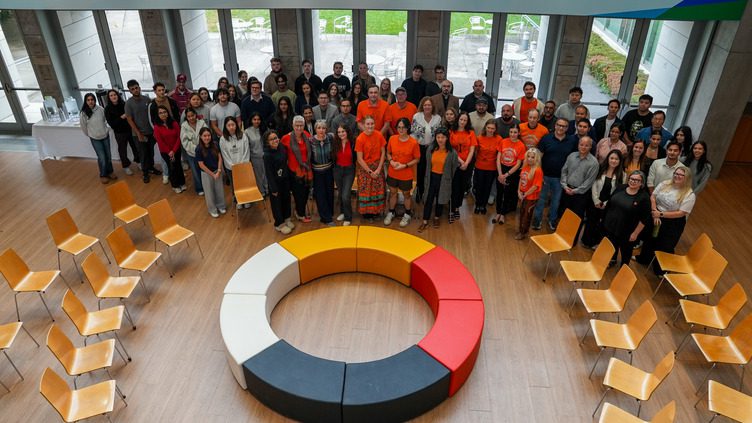
On September 30, the Schulich community came together to mark the National Day for Truth and Reconciliation, honouring residential school survivors and their families, remembering the children who never returned home, and reflecting on the lasting impacts of the residential school system. The morning gathering in the CIBC Marketplace included a Land Acknowledgement delivered by Natasha Lange (BBA ’27), a minute of silent reflection, and bannock and tea. Throughout the day, the Medicine Wheel Reflection Space offered students, faculty and staff a place to reflect on the themes of remembrance, reconciliation and respect, with a reflection board available for members of the community to share their thoughts and personal commitments.
Professor Charles Cho’s (Professor of Sustainability Accounting; Erivan K. Haub Chair in Business & Sustainability) research has examined Indigenous rights and environmental governance in the context of Canada’s transition to a low-carbon economy. His research explores how organizations engage with Indigenous communities and the role of free, prior and informed consent in major development projects. Charles is currently working in close collaboration with Indigenous scholar, Raylene Whitford, on a project clarifying consent in Canada’s clean growth transition. Raylene will join York/Schulich in January 2027 as a recipient of the Provost’s Postdoctoral Fellowship for Indigenous Scholars, with Charles as her postdoctoral supervisor.
Charles is also the faculty host for the recent York University’s Indigenous Pathways Program on behalf of Schulich School for Indigenous Lifelong Learners Day.
Professor Irene Henriques, (Professor of Sustainability & Business Economics & Policy; Area Coordinator, Business Economics & Policy) has conducted extensive research on Indigenous entrepreneurship, Indigenous procurement and economic reconciliation. Her work explores pathways to strengthen Indigenous participation in economic development and create more inclusive business practices. Irene has published a number of papers related to Indigenous procurement processes and Indigenous entrepreneurship, including (but not limited to):
- Henriques, I., Colbourne, R., Eva, C., Pirini, J., Allen, B. & Peredo, A.M. (2026) Towards inclusive prosperity: comparative analysis of Indigenous procurement policies in Canada, Australia, and New Zealand. Public Management Review, forthcoming. http://dx.doi.org/10.1080/14719037.2026.2720045
- Henriques, I., Colbourne, R., Peredo, A.M., Anderson, R. & Wanuch, R. (2024) Transforming Indigenous Procurement: Empowerment, Challenges, and the Road Ahead. Journal of Aboriginal Economic Development. 14(1): 2-15. https://doi.org/10.29173/jaed9
- Colbourne, R., Peredo, A. M. & Henriques, I. (2024) Indigenous Entrepreneurship? Setting the Record Straight. Business History. 66(2): 455-477. https://doi.org/10.1080/00076791.2023.2166034
Associate Professor Emeritus Fred Lazar (Associate Professor Emeritus of Business Economics & Policy) has contributed research and policy analysis related to Indigenous land claims, treaty land entitlement and economic development. His work has informed discussions on government policy and the economic implications of Indigenous rights and agreements. Fred has provided expert-level reporting on the Treaty 1 Annuity case and has worked as an advisor/consultant to a number of First Nations in land claims and treaty entitlement cases including Ginoogaming First Nation; Biinjitiwaabik Zaaging Anishinaabek First Nation; Biigtigong Nishnaabeg Anishnabe First Nation; Netmizaaggamig Nishnaabeg First Nation; and the Animbigoo Zaagi’igan Anishinaabek First Nation.
Professor Moshe A. Milevsky (Professor of Finance; CIT Chair in Financial Services) has explored retirement security and pension-related issues affecting First Nations communities, contributing to conversations around financial well-being and long-term economic sustainability. Moshe is currently developing a research paper entitled “Is there a Raison D’etre for a separate First Nations Pension Plan?”. A working paper can be found here.
Professor Dean Neu (Professor of Accounting) and Professor Gregory Saxton (Professor of Accounting) have collaborated on research examining inequities in public funding for First Nations children and communities. Their work has highlighted systemic gaps in public policy and accountability mechanisms, helping bring greater attention to issues of fairness and social justice. Dean and Greg have published a number of papers focusing on Indigenous-related issues, including (but not limited to):
- Neu, D., Liu, M. and Saxton, G.D. (2026), “Not monstrous but procedural: accounting for cruelty to First Nations children”, Accounting, Auditing & Accountability Journal, ahead of print, pp. 1- 28., doi: 10.1108/AAAJ-11-2025-8590.
- Liu, M., Taylor-Neu, K., Saxton, G.D., Neu, D., Rahaman, A.S. and Everett, J. (2025), “Indigenous peoples, environmental accountability and the semantic meaning of resource extraction firm disclosures”, Accounting, Auditing & Accountability Journal, Vol. 38 No. 5, pp. 1375-1404, doi: 10.1108/AAAJ-03-2024-6935. (NOTE: Developed in collaboration with Schulich faculty members Jeff Everett (Professor of Accounting) and Abu Shiraz Rahaman (Professor of Accounting).)
Dean Neu recently appeared in the investigative documentary The Good Canadian, which connected the present-day dispossession of Indigenous peoples to the bureaucratic and administrative structures that emerged under the Indian Act.